Biodiversity + Business: Understanding the Urgency and Investment Opportunities
As sustainability considerations continue to shape investment strategies, biodiversity is emerging as a critical focus area for investors and entrepreneurs.
The growing attention to biodiversity is taking a similar track to climate tech. The need to intensify the fight against climate change led to ESG regulation that created markets for new tech categories. Now, scientists are sounding the alarm about the catastrophic effects on the natural world.
We are witnessing what scientists term the "sixth mass extinction crisis," with extinction rates of species 100 to 1,000 times higher than the natural baseline over the past 10 million years. The statistics are sobering: 85% of the world's wetlands have disappeared, 50% of coral reefs have been lost since 1870, and between 1970 and 2018, wild vertebrate populations decreased by 69% on average.
Beyond the potential to make the planet uninhabitable over the long term, this devastation is already creating an immense risk that businesses are only just beginning to recognize. Regulators, especially in Europe, are working on rules to push back against that tide. The urgent need for solutions combined with expected rules and laws has nurtured an emerging category of “Nature Tech” that presents an opportunity to investors.
While this market is still nascent, the Revaia team has been studying the dynamics that are driving Nature Tech. The first step was to develop a framework for how to understand the key elements of biodiversity. To encourage greater attention to this critical topic, we wanted to share some of our key insights.
What is Biodiversity?
Biodiversity encompasses three fundamental pillars: genetic diversity (variety within species), species diversity (variety of life forms within habitats), and ecosystem diversity (variety of habitats and their interactions). The planet has three “biomes” or macro ecosystems: the marine environment (seas, oceans), land, and freshwater (rivers, lakes).
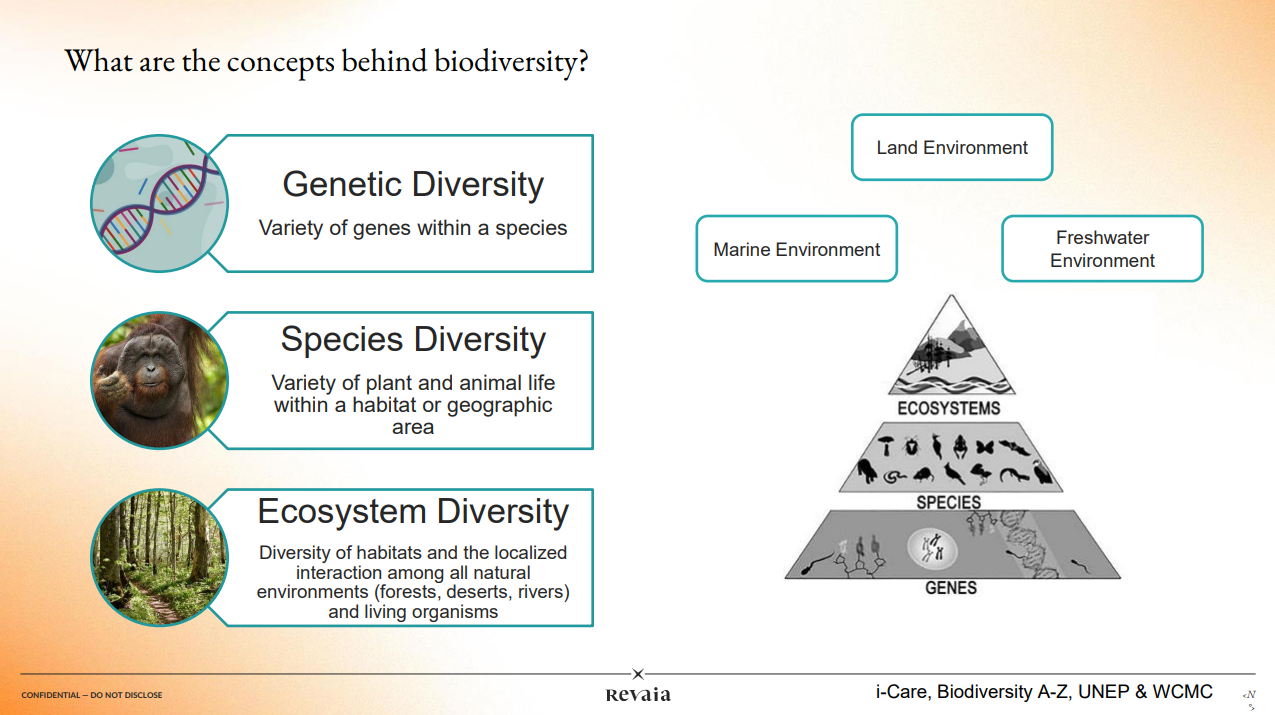
Diversity is the key. A wide variety of species leads to abundance and makes the planet a livable space.
Biodiversity is one of the nine planetary boundaries, a framework that identifies the limits within which humanity can safely operate, ensuring a stable Earth system that supports human civilization. Six of those boundaries have already been surpassed, meaning that we crossed a limit where irreversible harm has been done to the planet, according to the Stockholm Resilience Centre.
The crisis of biodiversity loss is being accelerated by five major factors: the direct pollution of natural habitats, the fallout from climate change, rising sea levels, overexploitation of resources, and the arrival of alien species. These factors are causing species to flee their homes, or disappear because they are unable to adapt. Whole living ecosystems are either being destroyed or fragmented.
All of this is caused by human activity. But because we are the ones responsible for it, we are also the ones who can develop the solutions that stop this downward spiral and restore these living ecosystems.
Economic Dependencies and Business Risks
It’s not too dramatic to say that the future of humanity and the planet depend on our ability to halt the destruction of biodiversity. But while the existential possibility may seem too abstract to grasp, the immediate impact on the economy is coming into focus.
The business case for biodiversity preservation has become increasingly clear as research shows deep interconnections between natural systems and economic activity. Approximately 50% of global GDP (around $44 trillion) depends moderately or highly on nature and its resources according to WEF. That making biodiversity a fundamental pillar of global economic stability.
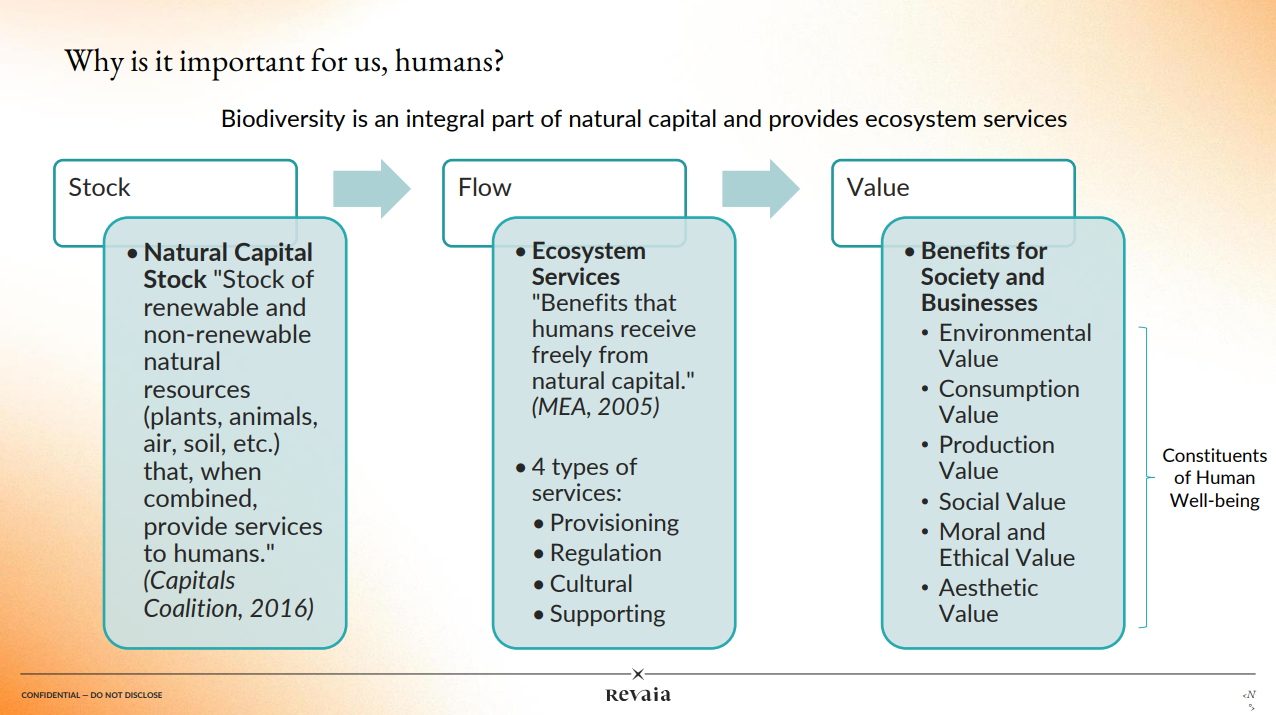
The relationship between business and biodiversity can be understood through a framework similar to financial capital known as “Natural Capital Stock.”
Just as a company has stock for shareholders, Natural Capital Stock includes assets like plants, animals, air, and soil. This Natural Capital Stock furnishes many of the most essential resources that we use in our economy.
The World Economic Forum now ranks biodiversity loss and ecosystem collapse as the third most significant long-term risk to the global economy. Key sectors with high biodiversity impact include agriculture, food, manufacturing, tourism, healthcare, construction, and energy.
These industries depend on the raw materials provided by nature while at the same time operating in ways that are detrimental to biodiversity. As a result, there is a growing risk of supply chain disruptions, resource scarcity, increased raw material costs, and regulatory compliance costs.
This interdependence means businesses are cutting the branches they are sitting on.
The Regulatory Landscape: A "Tsunami" of Change
There is both a human and economic imperative to find a better way to manage the pressures the economy is placing on biodiversity. Fortunately, there is increased awareness of the biodiversity crisis that is leading to regulatory efforts to address it.
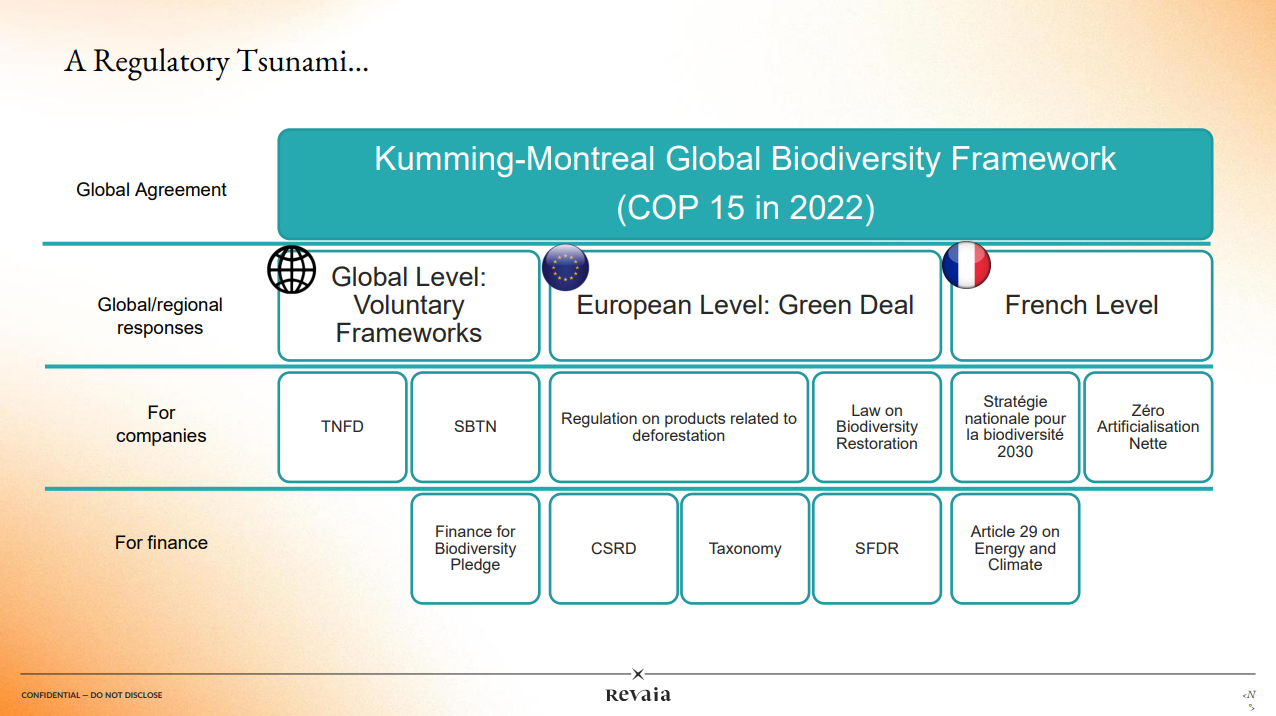
In 2022, world leaders at the COP 15 summit adopted the Kumming-Montreal Global Biodiversity Framework. Countries committed to setting national targets for protecting biodiversity. The framework sets out key agreements for monitoring, reporting, and scientific cooperation on biodiversity. Many of the other global commitments remain voluntary for now, such as the Finance for Biodiversity Pledge, the Task Force for Nature Financial Discloser (TNFD), and the Science-based Targets for Nature (SBTN).
At the European level, biodiversity is a part of the Green Deal package which includes regulations related to things like deforestation and nature restoration. Biodiversity was already part of previous regulations SFDR and CSRD that require companies to also report and disclose their biodiversity impact.
France is a bit more advanced than other countries with pioneering initiatives such as the National Biodiversity Strategy 2030 which sets comprehensive targets for biodiversity protection and restoration and provides a roadmap for public and private sector action. The country has also adopted a Zero Net Artificialization regulation that restricts the conversion of natural habitats into built environments to prevent habitat loss and fragmentation. Finally, Article 29 on Energy and Climate Law requires mandatory reporting on biodiversity metrics for financial institutions and large companies to promote the integration of biodiversity considerations into investment decisions.
This regulatory evolution suggests that biodiversity considerations will soon become as central to business operations as climate-related factors are today. Companies and investors should prepare for increased scrutiny and reporting requirements, while also identifying opportunities to lead in biodiversity preservation and restoration.
Investment Opportunities in the Nature Tech Market
The emerging "Nature Tech" sector is still small, but growing. According to a PwC analysis, investment in this sector has grown to approximately $2 billion in 2022, with an impressive average growth rate of 52% per year since 2018. For now, investments are concentrated in the early stages, primarily from pre-seed to Series A.
While the United States has historically led in Nature Tech investment, Europe is gaining ground, particularly in early-stage funding. In 2023, Europe outpaced the US in early-stage investments, suggesting a maturing ecosystem for nature tech innovation in the region.
The categories in this market include the development of nature-positive products, sustainable supply chain innovations, biodiversity credits, ecosystem restoration projects, and MRV (Measurement, Reporting, and Verification).
But the importance of this trend is not limited to companies developing Nature Tech. All companies will still need to understand their relationship with biodiversity, especially as more regulations are adopted. This will be critical to reputation management, stakeholder expectations, competitive advantage, and long-term business resilience.
Looking Ahead: Investment Considerations
For investors and entrepreneurs considering the biodiversity space, there are several factors worth tracking to monitor how quickly the space is evolving:
1. Regulatory Momentum: The increasing regulatory focus suggests growing market opportunities for solutions that help businesses comply with new requirements.
2. Market Maturation: The evolution from early-stage to growth-stage opportunities indicates a maturing market with potential for significant returns.
3. Technology Integration: Successful solutions often combine multiple technologies (AI, satellite imaging, biotechnology) to address complex biodiversity challenges.
4. Impact Measurement: The development of standardized metrics (like Mean Species Abundance per square kilometer) will be crucial for market growth.
5. Cross-sector Applications: The most promising opportunities may lie in solutions that address multiple environmental challenges simultaneously (e.g., climate change and biodiversity loss).
Early movers in this space have the opportunity to capture significant market share while contributing to essential environmental preservation. The convergence of regulatory pressure, market demand, and technological innovation suggests that biodiversity-focused solutions will remain a growing investment opportunity for years to come.
Companies that understand and actively manage their relationship with biodiversity will be better positioned for long-term success in an increasingly environmentally conscious market. As investors, we can influence companies to better manage those dependencies while providing financial support to entrepreneurs building the solutions the planet urgently needs.
The time has come to recognize that protecting biodiversity isn't just an environmental imperative—it's a business opportunity upon which our entire economic system depends.